Jethro Tull (ENGLAND)
Posted: 24 Feb 2025, 08:19
Jethro Tull - The String Quartets (2017)



Year : 2017
Style : Progressive Rock , Symphonic Rock
Country : United Kingdom
Audio : 320 kbps + scans
Size : 110 mb
Bio:
Jethro Tull were a British rock group, formed in Luton, Bedfordshire, on December 20, 1967.Initially playing blues rock, the band soon developed its sound to incorporate elements of British folk music and hard rock to forge a progressive rock signature.The band was led by vocalist/flautist/guitarist Ian Anderson, and featured a revolving door of lineups through the years including significant members such as longtime guitarist Martin Barre, keyboardist John Evan, drummers Clive Bunker, Barriemore Barlow, and Doane Perry, and bassists Glenn Cornick, Jeffrey Hammond, and Dave Pegg.The group first achieved commercial success in 1969, with the folk-tinged blues album Stand Up, which reached No. 1 in the UK charts, and they toured regularly in the UK and the US. Their musical style shifted in the direction of progressive rock with the albums Aqualung (1971), Thick as a Brick (1972) and A Passion Play (1973), and shifted again to hard rock mixed with folk rock with Songs from the Wood (1977) and Heavy Horses (1978). Jethro Tull have sold over 60 million albums worldwide,[3] with 11 gold and five platinum albums among them.They have been described by Rolling Stone as "one of the most commercially successful and eccentric progressive rock bands".The last works as a group to contain new material were released in 2003, though the band continued to tour until 2011. In April 2014, as he was concentrating on his solo career, Anderson said that Jethro Tull were finished.
Album:
Jethro Tull - The String Quartets is a studio album by Jethro Tull frontman Ian Anderson, featuring the Carducci String Quartet, conducted by John O'Hara.It will be released on March 24, 2017.‘Jethro Tull: The String Quartets’ is in fact Ian Anderson plus The Carducci Quartet on an album orchestrated by Anderson’s long time collaborator John O’Hara. The result is a refreshing interpretation of some of Tull’s back catalogue, leaving the fans to argue about what was left out.This is the kind of album that asks some awkward questions about whether a rock audience has now matured to the point where it can appreciate chamber music renditions of a band whose musical career spans folk, prog and heavy rock. Also how many versions of these songs do fans still want to hear?Whatever the answer, there’s plenty to enjoy here, as O’Hara sets about Anderson’s material with gusto. The quartet’s subtle dynamics pick out the musical highlights, before they explore the outer fringes of the material. In the case of ‘We Used To Bach’ (aka ‘We Used To Know’) Anderson’s song is cleverly segued with the original influence for the song, ‘Bach Prelude C Major’.Tull’s music has already been through the classical blender before of course, but this string quartet album brings a lively, jaunty presence to bear on a thoughtfully compiled set of songs, albeit it includes two Christmas songs.The key to the project is the strength of the material. String quartets were after all considered to be the ultimate test for a composer’s art and for the most part the songs benefit from the ‘unplugged’ approach. ‘Bungle’ (aka ‘Bungle In The Jungle’) for example, is given a more accessible lighter feel, in sharp contrast to rather more lumbering original, and ‘Ring Out Those Bells’ (aka ‘Ring Out Solstice Bells’) has a joyous feel as Ian adds one of 6 passable vocals on the album.Then there’s the strange choice of ‘Pass The Bottle’, a wry seasonal ditty which retains the Eastern sounding mandolin, while adding a busy string arrangement that helps builds it up impressively. Anderson voices the original outro with a distinctly southern vowel sound compared to the more flat original: ‘hey Santa pass us that bottle will ya”Recorded at Worcester Cathedral and St. Kenelms’s Church in Sapperton, Gloucestershire, the album gets off to a brave start with the Tull classic, ‘Living In The Past’. Retitled ‘In The Past’, the 12 different titles reflect the different musical approaches and different players from the original band.‘In The Past’ opens with a gently thumbed strings and Anderson’s flute which deftly meanders in between the strings as the quartet works its way back to the theme.‘Sossity Waiting’ (‘Sossity, You’re A Woman/Reasons For Waiting’) doesn’t quite work as well, if only because it’s a segued piece on which the original acoustic number is well suited to the string arrangement. The latter was was already orchestrated and even though it’s beautifully voiced here, the quartet arrangement doesn’t really add anything to the original, though it does serve to remind us you of the potency of Anderson’s melodies.The folky material seems better fitted to purpose, most notably on the uplifting feel of ‘Songs And Horses’ (aka ‘Songs From The Wood/Heavy Horses’), one of only two tracks to feature the quartet on their own. The staccato nature of the song and the melodic resolution is beautifully captured by purity of the strings on a piece full of subtle dynamics.The link piece ‘Only The Giving’ (aka ‘Wond’ring Aloud’) stays much closer to the original acoustic arrangement, until a startling violin drop-in at 35 seconds, before the strings recover to colour the piece with intricate bowed strings.Die hard fans will want to hear what has been made of the two Tull heavy hitters, ‘Loco, (‘Locomotive Breath’) and ‘Aquafugue’ (‘Aqualung’). ‘Loco’ is a highlight, particularly as Ian’s excellent flute is offset by the strings as they map out the melody line.‘Aquafugue’ is given a more sonorous reading with the repeated riff punctuating a sombre claustrophobic sounding piece, before a spirited unison of strings and a belated vocal (the least impressive on the album).The flute and string double lines nearly obscure Anderson’s vocal, while the Celeste sounds a bit heavy handed, almost as if trying to mirror the bombast of the original version.Given that it’s the last song on the album it’s a slightly low key finish to an otherwise enjoyable album, which for all its endeavour and sense of adventure will probably be for completists only.
Line Up:
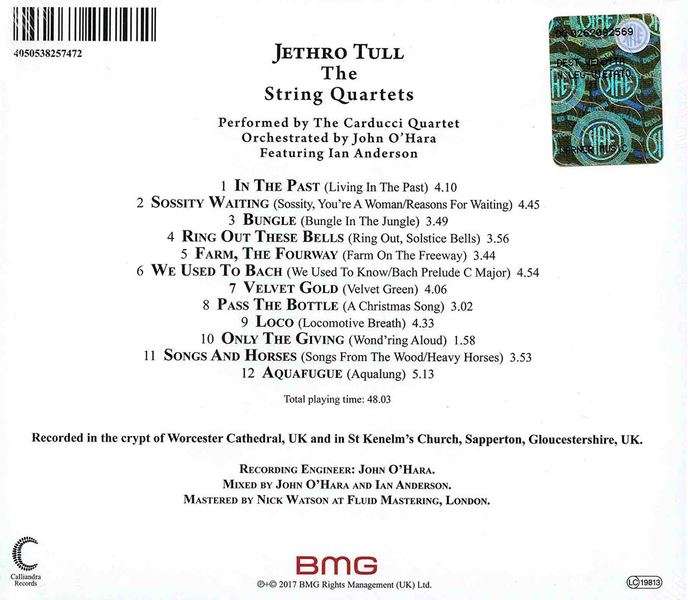
Matthew Denton – violin
MIchelle Fleming – violin
Eoin Schmidt-Martin – viola
Emma Denton – cello
Ian Anderson – flute, vocals, acoustic guitar, mandolin
John O'Hara - orchestral arrangements, celesta, piano
Tracklist:
01. In the Past (Living In The Past)
02. Sossity Waiting (Sossity: You’re a Woman / Reasons For Waiting)
03. Bungle (Bungle In The Jungle)
04. We Used to Bach (We Used to Know / Bach Prelude C Major)
05. Farm, the Fourway (Farm On The Freeway)
06. Songs and Horses (Songs From The Wood / Heavy Horses)
07. Only the Giving (Wond’ring Aloud)
08. Loco (Locomotive Breath)
09. Pass the Bottle (A Christmas Song)
10. Velvet Gold (Velvet Green)
11. Ring Out These Bells (Ring Out, Solstice Bells)
12. Aquafugue (Aqualung)


Download links for all albums only on our blog here: http://goodmetalandhar.do.am/

Year : 2017
Style : Progressive Rock , Symphonic Rock
Country : United Kingdom
Audio : 320 kbps + scans
Size : 110 mb
Bio:
Jethro Tull were a British rock group, formed in Luton, Bedfordshire, on December 20, 1967.Initially playing blues rock, the band soon developed its sound to incorporate elements of British folk music and hard rock to forge a progressive rock signature.The band was led by vocalist/flautist/guitarist Ian Anderson, and featured a revolving door of lineups through the years including significant members such as longtime guitarist Martin Barre, keyboardist John Evan, drummers Clive Bunker, Barriemore Barlow, and Doane Perry, and bassists Glenn Cornick, Jeffrey Hammond, and Dave Pegg.The group first achieved commercial success in 1969, with the folk-tinged blues album Stand Up, which reached No. 1 in the UK charts, and they toured regularly in the UK and the US. Their musical style shifted in the direction of progressive rock with the albums Aqualung (1971), Thick as a Brick (1972) and A Passion Play (1973), and shifted again to hard rock mixed with folk rock with Songs from the Wood (1977) and Heavy Horses (1978). Jethro Tull have sold over 60 million albums worldwide,[3] with 11 gold and five platinum albums among them.They have been described by Rolling Stone as "one of the most commercially successful and eccentric progressive rock bands".The last works as a group to contain new material were released in 2003, though the band continued to tour until 2011. In April 2014, as he was concentrating on his solo career, Anderson said that Jethro Tull were finished.
Album:
Jethro Tull - The String Quartets is a studio album by Jethro Tull frontman Ian Anderson, featuring the Carducci String Quartet, conducted by John O'Hara.It will be released on March 24, 2017.‘Jethro Tull: The String Quartets’ is in fact Ian Anderson plus The Carducci Quartet on an album orchestrated by Anderson’s long time collaborator John O’Hara. The result is a refreshing interpretation of some of Tull’s back catalogue, leaving the fans to argue about what was left out.This is the kind of album that asks some awkward questions about whether a rock audience has now matured to the point where it can appreciate chamber music renditions of a band whose musical career spans folk, prog and heavy rock. Also how many versions of these songs do fans still want to hear?Whatever the answer, there’s plenty to enjoy here, as O’Hara sets about Anderson’s material with gusto. The quartet’s subtle dynamics pick out the musical highlights, before they explore the outer fringes of the material. In the case of ‘We Used To Bach’ (aka ‘We Used To Know’) Anderson’s song is cleverly segued with the original influence for the song, ‘Bach Prelude C Major’.Tull’s music has already been through the classical blender before of course, but this string quartet album brings a lively, jaunty presence to bear on a thoughtfully compiled set of songs, albeit it includes two Christmas songs.The key to the project is the strength of the material. String quartets were after all considered to be the ultimate test for a composer’s art and for the most part the songs benefit from the ‘unplugged’ approach. ‘Bungle’ (aka ‘Bungle In The Jungle’) for example, is given a more accessible lighter feel, in sharp contrast to rather more lumbering original, and ‘Ring Out Those Bells’ (aka ‘Ring Out Solstice Bells’) has a joyous feel as Ian adds one of 6 passable vocals on the album.Then there’s the strange choice of ‘Pass The Bottle’, a wry seasonal ditty which retains the Eastern sounding mandolin, while adding a busy string arrangement that helps builds it up impressively. Anderson voices the original outro with a distinctly southern vowel sound compared to the more flat original: ‘hey Santa pass us that bottle will ya”Recorded at Worcester Cathedral and St. Kenelms’s Church in Sapperton, Gloucestershire, the album gets off to a brave start with the Tull classic, ‘Living In The Past’. Retitled ‘In The Past’, the 12 different titles reflect the different musical approaches and different players from the original band.‘In The Past’ opens with a gently thumbed strings and Anderson’s flute which deftly meanders in between the strings as the quartet works its way back to the theme.‘Sossity Waiting’ (‘Sossity, You’re A Woman/Reasons For Waiting’) doesn’t quite work as well, if only because it’s a segued piece on which the original acoustic number is well suited to the string arrangement. The latter was was already orchestrated and even though it’s beautifully voiced here, the quartet arrangement doesn’t really add anything to the original, though it does serve to remind us you of the potency of Anderson’s melodies.The folky material seems better fitted to purpose, most notably on the uplifting feel of ‘Songs And Horses’ (aka ‘Songs From The Wood/Heavy Horses’), one of only two tracks to feature the quartet on their own. The staccato nature of the song and the melodic resolution is beautifully captured by purity of the strings on a piece full of subtle dynamics.The link piece ‘Only The Giving’ (aka ‘Wond’ring Aloud’) stays much closer to the original acoustic arrangement, until a startling violin drop-in at 35 seconds, before the strings recover to colour the piece with intricate bowed strings.Die hard fans will want to hear what has been made of the two Tull heavy hitters, ‘Loco, (‘Locomotive Breath’) and ‘Aquafugue’ (‘Aqualung’). ‘Loco’ is a highlight, particularly as Ian’s excellent flute is offset by the strings as they map out the melody line.‘Aquafugue’ is given a more sonorous reading with the repeated riff punctuating a sombre claustrophobic sounding piece, before a spirited unison of strings and a belated vocal (the least impressive on the album).The flute and string double lines nearly obscure Anderson’s vocal, while the Celeste sounds a bit heavy handed, almost as if trying to mirror the bombast of the original version.Given that it’s the last song on the album it’s a slightly low key finish to an otherwise enjoyable album, which for all its endeavour and sense of adventure will probably be for completists only.
Line Up:
Matthew Denton – violin
MIchelle Fleming – violin
Eoin Schmidt-Martin – viola
Emma Denton – cello
Ian Anderson – flute, vocals, acoustic guitar, mandolin
John O'Hara - orchestral arrangements, celesta, piano
Tracklist:
01. In the Past (Living In The Past)
02. Sossity Waiting (Sossity: You’re a Woman / Reasons For Waiting)
03. Bungle (Bungle In The Jungle)
04. We Used to Bach (We Used to Know / Bach Prelude C Major)
05. Farm, the Fourway (Farm On The Freeway)
06. Songs and Horses (Songs From The Wood / Heavy Horses)
07. Only the Giving (Wond’ring Aloud)
08. Loco (Locomotive Breath)
09. Pass the Bottle (A Christmas Song)
10. Velvet Gold (Velvet Green)
11. Ring Out These Bells (Ring Out, Solstice Bells)
12. Aquafugue (Aqualung)
Download links for all albums only on our blog here: http://goodmetalandhar.do.am/


